 Celebrity Media TV
“De-escalation” Must Be More Than a Slogan
Addressing the Middle East, Guterres repeatedly stressed that de-escalation must be the first, second, and third priority. He called for an end to harm against civilians, guaranteed access for humanitarian assistance, and the restoration of freedom of navigation through the Strait of Hormuz and the Bab el-Mandeb Strait. He also advocated diplomacy and dialogue to end the escalation of conflict.
This sense of urgency is necessary. The two straits affect not only countries in the region, but also global energy supplies, trade, and food transportation. If military conflict causes shipping routes to remain disrupted for an extended period, the cost will be borne not only by the warring parties, but also by poorer countries that depend on imported energy and food.
However, merely calling on “all parties to exercise restraint” also has limitations. The various actors do not possess equal military capabilities, bear equal political responsibility, or have the same impact on civilians. If the international community relies only on vague and symmetrical language without holding specific actors accountable for specific conduct, de-escalation may become a demand that victims and perpetrators bear equal responsibility.
The purpose of diplomacy should not simply be to reduce the intensity of conflict temporarily. It should establish mechanisms capable of protecting civilians, ensuring the delivery of aid, and holding those responsible for unlawful conduct accountable. A ceasefire without accountability may merely become an interval before the next war, while humanitarian assistance without a political solution can do little more than repeatedly address the consequences of conflict.
The Israeli-Palestinian Conflict Remains the Central Issue the Middle East Cannot Avoid
Guterres explicitly called for the full implementation of the Gaza peace plan, unrestricted access for humanitarian assistance, and an end to the gradual annexation of land in the West Bank and actions that could result in the forced displacement of the population. He once again placed the two-state solution on the negotiating table, emphasizing that there can be no genuine peace in the Middle East until the Israeli-Palestinian conflict is resolved.
In recent years, the international community has repeatedly discussed expanding regional cooperation and establishing a new security architecture, while often attempting to bypass the Israeli-Palestinian issue. Reality has demonstrated that the political rights and security concerns of Palestinians will not automatically disappear simply because other countries establish diplomatic relations with one another.
The difficulties confronting the two-state solution, however, are no longer merely the absence of another round of negotiations. Its foundations on the ground are being steadily eroded. Settlement expansion, territorial fragmentation, recurring violence, and declining trust between the two sides are making the two-state solution increasingly difficult to implement. If the international community continues to support this solution, it must explain how it intends to stop unilateral actions that alter realities on the ground, rather than merely repeating an increasingly hollow objective in official statements.
From Ukraine to Sudan: Can International Rules Be Applied Consistently?
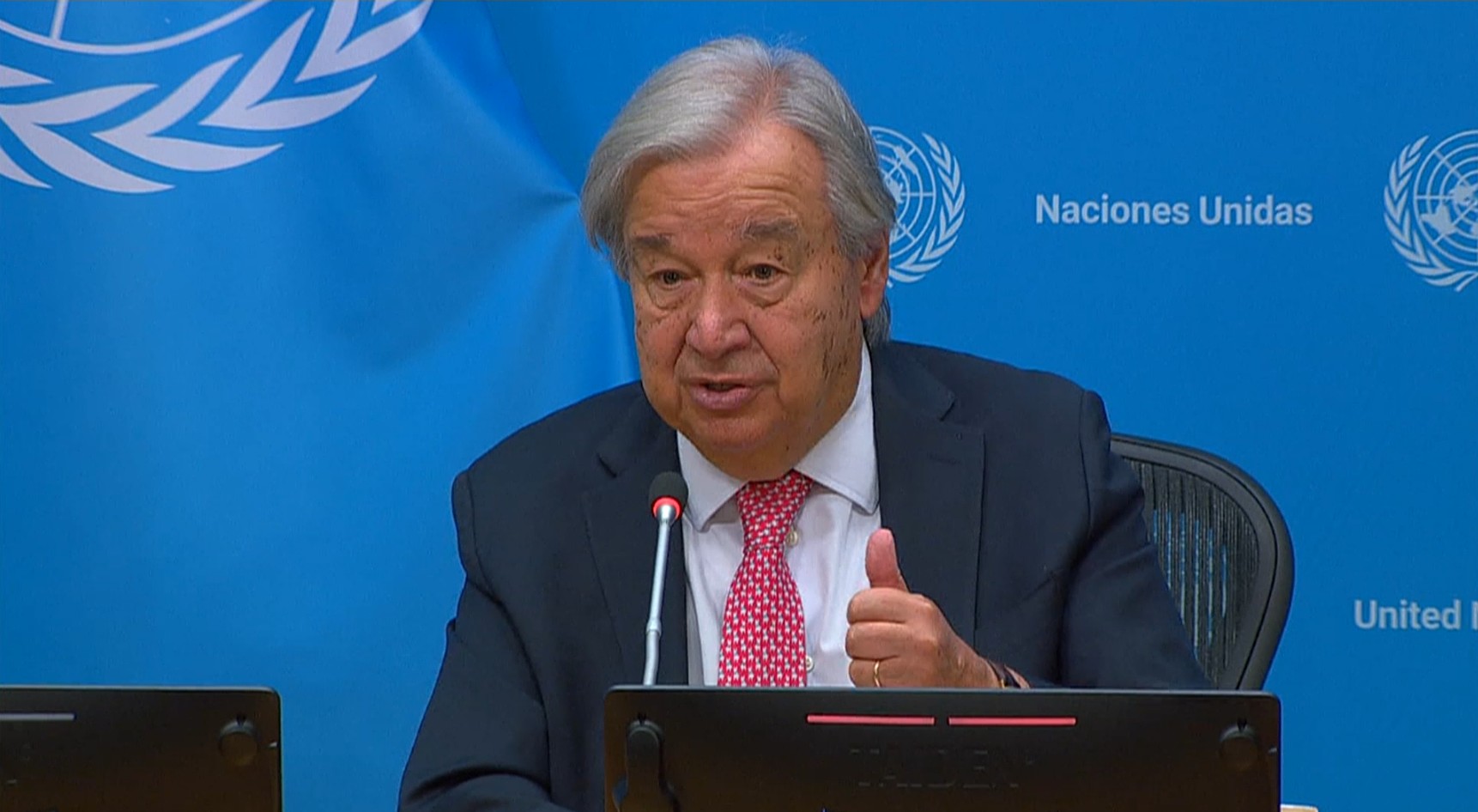
Regarding the Russia-Ukraine war, now entering its fifth year, Guterres called for an immediate ceasefire and described it as the first step toward a just, lasting, and comprehensive peace. “Just” and “lasting” are equally important. A ceasefire can reduce casualties, but if it tacitly accepts the alteration of borders through force, it may send a dangerous message to the world: As long as an aggressor can endure the costs of war for a sufficient length of time, the gains of aggression may eventually be accepted by the international community.
This is also a fundamental contradiction confronting the United Nations system. The UN Charter requires the protection of national sovereignty and territorial integrity, yet the permanent members of the Security Council possess veto power. When a major power is itself involved in a war, the United Nations faces severe constraints in enforcing its own principles.
Guterres also reminded the world that peace in the Horn of Africa will remain impossible unless the crisis in Sudan is resolved. This point deserves particular attention. International attention is distributed extremely unevenly among different wars, yet the hunger, displacement, and violence suffered by Sudanese civilians are not diminished simply because they receive less coverage in the headlines. The credibility of the United Nations also depends on whether it gives equal weight to the lives of people in different regions and from different ethnic groups.
Artificial Intelligence Is Becoming a New Battleground for Global Governance
Guterres devoted nearly half of his remarks to artificial intelligence, demonstrating that AI is no longer merely an issue for the technology industry. It has become a matter of global governance closely connected to warfare, employment, education, healthcare, the manipulation of public opinion, and national security.
Artificial intelligence can indeed advance disease diagnosis, personalized education, and climate research. However, technological development is moving faster than many countries can establish legal, regulatory, and social-protection mechanisms. Even more concerning is that the computing resources, data, and foundational models required for AI are concentrated primarily in a small number of countries and major corporations. Without global coordination, AI may not only widen the technological gap between countries, but also further concentrate wealth and power.
AI governance therefore cannot be limited to discussing whether the technology is safe. It must also answer several political questions: Who makes the rules? Who owns the data? Who profits from the technology? Who is responsible when it causes errors or harm? Will developing countries be reduced to users of technological products and sources of data?
The United Nations can provide a platform for global dialogue, but it cannot be satisfied with issuing declarations of principle. The international community must establish enforceable safety standards, accountability mechanisms, and cross-border regulatory arrangements, while preventing “AI safety” from becoming a tool used by a small number of countries to restrict the development of others.
Women’s Rights Are a Test of International Principles
Guterres used the forceful phrase “absolutely intolerable” to describe the situation facing women and girls in Afghanistan. Women are prohibited from working at United Nations premises, girls face restrictions on education, and employment opportunities for women have been drastically reduced. These policies not only violate fundamental rights, but also directly undermine Afghanistan’s ability to receive humanitarian assistance and achieve long-term development.
The question is how the international community can translate “intolerance” into effective action. Completely isolating Afghanistan would impose the greatest cost on ordinary people, particularly women and children. Yet restoring normal relations with the Taliban authorities without conditions could amount to de facto acceptance of their policies of repressing women.
The international community must distinguish between assisting civilians and recognizing a government. While ensuring that humanitarian assistance continues uninterrupted, it should make women’s access to education, employment, and participation in public life essential conditions for continued engagement. Women’s rights must not become bargaining chips that countries can trade away during diplomatic negotiations.
The United Nations Needs More Than Reform—it Needs Political Will
Guterres’s final General Assembly is likely to serve as a comprehensive reflection on his decade-long tenure. He confronts a world that is more divided than before: Wars are increasing, competition among major powers is intensifying, multilateral institutions are being questioned, and emerging technologies such as artificial intelligence are creating risks that traditional international rules are not yet prepared to address.
His commitment to multilateralism has practical significance because climate change, the spillover effects of war, refugee crises, infectious diseases, and the risks posed by artificial intelligence cannot be addressed by any single country acting alone. At the same time, multilateralism does not inherently represent justice. If international institutions cannot restrain powerful states, apply consistent standards to similar conduct, or turn declarations into action, countries’ trust in the international system will continue to decline.
Guterres said that updating institutions must not mean abandoning principles. This may be the most important part of his remarks. The world today does not need more eloquent international slogans. It needs countries that are willing to accept the constraints of principle even when doing so works against their own interests.
Whether the United Nations can continue to play a meaningful role will ultimately depend not only on what the Secretary-General says, but also on whether member states are willing to pay the political price necessary to allow diplomacy to rise above short-term calculations—and to ensure that international law restrains powerful states as well as weaker ones.